


There’s a saying in produce handling that the last mile doesn’t happen on the road, it happens in the bag. After years of supplying breathable mesh bags for onions to growers, packers, and distributors across Canada, we’ve seen how a seemingly minor packaging decision compounds into serious product loss. The onion bag sitting at the end of your supply chain is an active part of your storage system, and treating it like an afterthought is one of the most expensive habits in the business.
The Reason Your Onions Go Soft
Most people who deal in onions at volume have had this experience: a load comes in looking fine, and a few days later you’re cutting losses. The instinct is to blame the crop, the cold storage temperature, or the shipper. But more often than the industry admits, the bag is the culprit!
Onions are still biologically active after harvest. They continue to respire, releasing both heat and moisture into whatever space they’re sitting in. In a breathable environment, this moisture escapes. Stack those onions inside a bag that restricts airflow, and the moisture has nowhere to go. It settles and accumulates, and then you’ve got condensation building against the skin of the onion, which is essentially an invitation for rot.
Good ventilation is the difference between a load that holds well for weeks and one that starts softening in ten days.
Why Poly Mesh Became the Industry Standard
Polypropylene mesh bags landed where they did in produce handling because they solve two competing problems at once: structural strength and open airflow. The material is woven or extruded into a net pattern with consistent openings that let air circulate freely around every onion in the bag — not just the ones on the outside. That’s harder to achieve than it sounds.
Burlap bags, which were the traditional workhorse for produce storage for generations, are breathable but can absorb moisture, which creates its own problems in humid conditions. Plain poly bags for onions block airflow almost entirely and are essentially the worst possible choice for anything that respires. Mesh sits in the middle: strong, light, completely non-absorbent, and open enough to let the product breathe continuously, not conditionally.
For anyone moving onion storage bags in bulk, this combination is hard to beat.
Retail Bags vs. Bulk Onion Bags
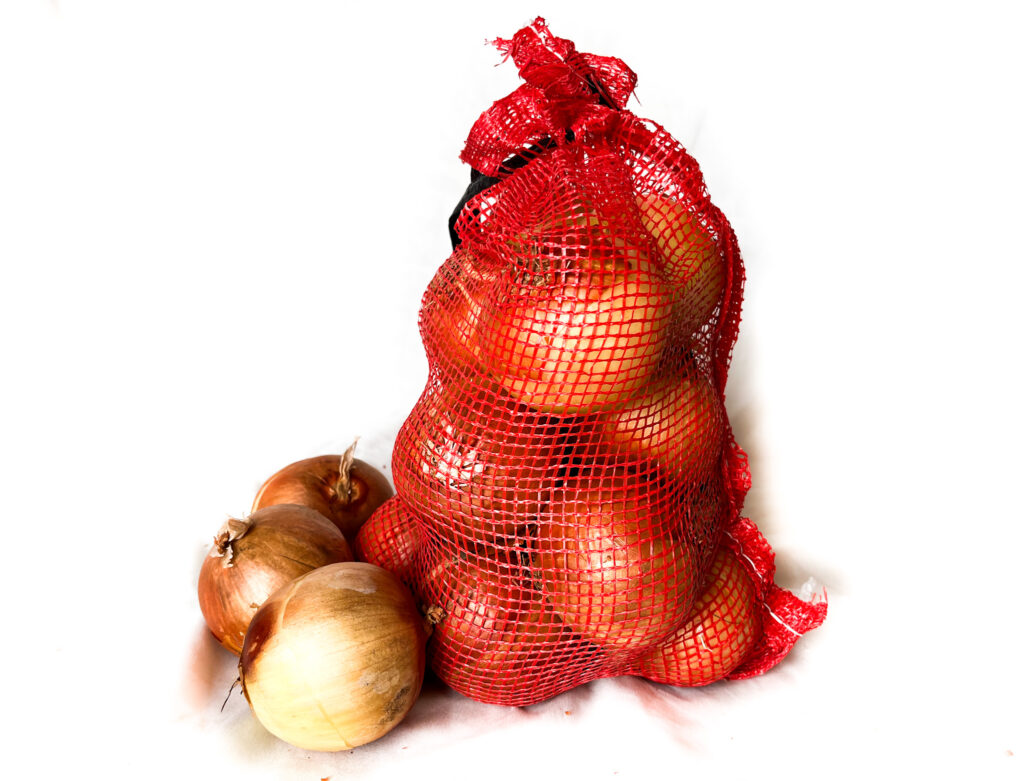
The mesh bag a customer picks up at a grocery store is built for a short, controlled life — a few days on a shelf, in a kitchen, maybe a week in a pantry. It’s lightweight, it’s inexpensive, and it’s designed to look good on a retail display.
Bulk onion bags are a different product category. The mesh is heavier gauge and the construction is more consistent across the bag, which makes for airflow uniformity when bags are stacked on pallets. The seams and closures are built to handle the mechanical stress of filling equipment, pallet stacking, and repeated transport without splitting. And, they’re often UV-stabilized for outdoor or semi-outdoor storage conditions, which retail bags often aren’t.
Using retail-grade bags for bulk storage or transit is one of the most common mistakes we see from buyers who are trying to cut costs on packaging. It can save money upfront, but it rarely saves money overall.
What Inconsistent Mesh Does to Your Product
If the mesh openings vary significantly across a bag — which happens with lower-quality tooling and materials — airflow through the bag becomes uneven. Pockets of restricted airflow form, typically at the bottom and in compressed areas, and those pockets are exactly where moisture accumulates first.
A well-made bulk onion bag has consistent mesh geometry from top to bottom. It sounds like a detail. Across a full pallet, stacked four or five bags high, it’s the difference between predictable storage performance and frustrating variability.
Four Places Suppliers Bleed Margin on Onion Bags
1. Overfilling
Overfilling compresses the onions in the lower half of the bag and physically reduces the airspace between them. Less airspace means less circulation, which means moisture builds faster in the most compressed zone — the bottom, where the weight concentrates. Most mesh bags for onions are sized and rated for specific fill weights, and staying within those parameters is a simple operational discipline that pays for itself.
2. Mismatched Bag Type for Storage Duration
A bag rated for transit and a bag rated for extended storage are different products. If you’re moving onions from point A to point B within 48 hours, a lighter-gauge bag gets the job done. If you’re holding product for two to four weeks before distribution, you need a bag with better structural integrity and airflow consistency. Using transit-grade bags for storage is one of those decisions that looks fine until it very much doesn’t.
3. Ignoring the Storage Environment
A breathable mesh bag can only do so much in a poorly ventilated facility. The bag works with the airflow that exists around it — it doesn’t create its own. If pallets are packed too tightly together, if ambient humidity is high and unchecked, or if the cooling system has dead zones, mesh bags will reduce spoilage compared to solid-wall packaging, but they won’t eliminate it. The bag and the environment are a system, and both parts need to be managed.
4. Buying on Price Alone
Commodity mesh bags are widely available, and the price variance across suppliers can look significant. What that price variance often reflects is tolerance consistency, material grade, UV stabilization, and seam construction; the attributes that determine whether a bag performs reliably over its full working life or starts creating problems at the worst possible moment. Across a full season’s worth of onion handling, the cost-per-bag difference between a quality mesh bag and a budget option is usually marginal. The difference in product loss is often not.
Onion Bags vs. Potato Bags: Similar, Maybe Not Interchangeable
Potatoes and onions get stored and sold in similar-looking bags, which creates a reasonable assumption that the bags themselves are interchangeable. They’re close, but not identical.
Onions are more sensitive to humidity and need maximum airflow, so their bags typically use a wider, more open mesh weave. Potatoes need good airflow too, but they’re also sensitive to light exposure, which can cause greening and solanine development. Potato bags are often produced in a darker colour or with a denser weave that limits light penetration while still allowing air to move through. Using a high-transparency onion bag for potatoes in a lit storage environment can degrade the product. Using a denser potato bag for onions reduces the airflow your crop needs.
If you’re sourcing mesh bags for both products, it’s worth specifying each separately rather than trying to find a one-size-fits-all solution.
Where to Source Onion Bags Wholesale in Canada
For Canadian growers and distributors looking for onion bags wholesale near you, lead times and logistics are every bit as important as bag quality. A supplier in the U.S. may offer competitive pricing, but cross-border shipping timelines and duties can eat into that advantage quickly, especially during peak harvest season when you need product reliably and on schedule.
St. Boniface Bag Co. has been supplying agricultural and produce bags to Canadian operations since 1952, with distribution that reaches across British Columbia, Alberta, and the rest of the country. Our mesh produce bags are sourced for bulk agricultural use, not retail display, and we work with buyers who are moving real volume and need consistent product they can count on.

Ready to Sort Out Your Onion Bag Supply?
If you’re dealing with product loss you can’t fully explain, or you’re scaling up your onion operation and want to make sure your packaging is keeping up, we’d rather have that conversation before it becomes an expensive problem. Get a quote from our team — we’ll help you figure out the right bag type, fill weight, and order volume for what you’re handling.
Because the right bag isn’t a small detail. It’s one of the better investments your storage operation can make. Give us a call to learn more about our produce bags and onion bags in bulk.